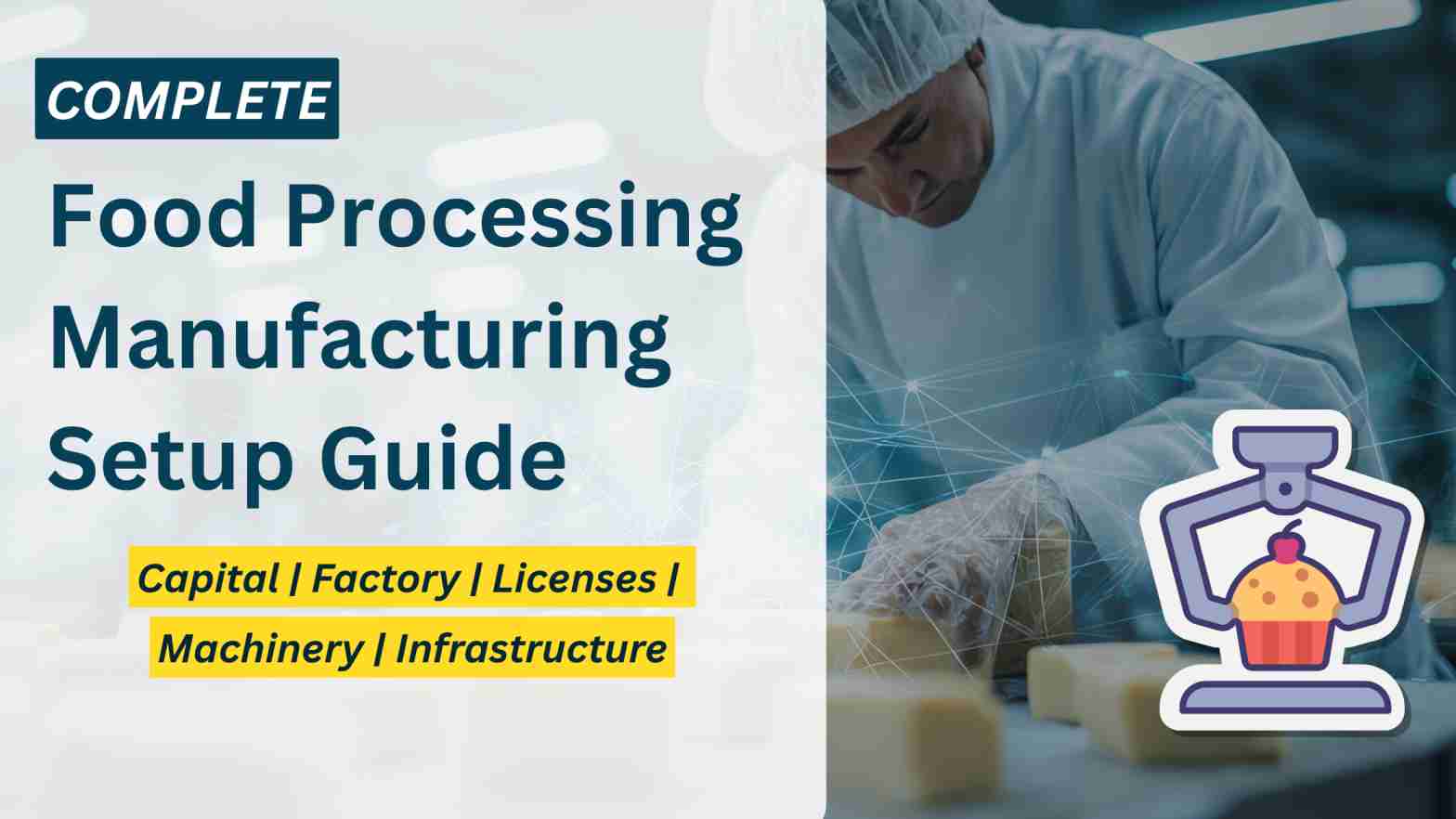
The Complete Guide to Setting Up a Food Processing Manufacturing Unit in India
The Indian food processing industry is one of the fastest-growing sectors, driven by increasing consumer demand, changing lifestyles, organized retail, exports, and government support. Whether you’re planning to manufacture spices, snacks, fruit products, dairy products, beverages, ready-to-eat meals, frozen foods, flour, edible oils, or nutraceutical products, your success depends on making the right decisions before investing.
Many first-time entrepreneurs focus only on the product idea but overlook critical questions related to capital investment, factory location, infrastructure planning, licenses, machinery selection, and production capacity. These decisions directly affect profitability, operational efficiency, and long-term scalability.
This guide answers the most important infrastructure and setup questions every food processing entrepreneur should consider before launching a manufacturing unit.
One of the biggest misconceptions among entrepreneurs is that there is a fixed investment required for every food processing business. In reality, the required capital depends on several factors, including:
This includes factory premises, production halls, warehouses, quality laboratories, administrative offices, utility rooms, and future expansion space.
Processing equipment, packaging machines, material handling systems, conveyors, storage tanks, refrigeration systems, and utilities generally account for the largest share of capital expenditure.
Infrastructure investments typically include:
Many entrepreneurs underestimate working capital. You need sufficient funds for:
A healthy business ensures enough working capital to operate comfortably for several production cycles before achieving consistent cash flow.
This decision depends on your investment capacity, business strategy, and long-term vision.
Leasing offers several advantages:
Leasing is generally suitable for startups, pilot production, and businesses validating market demand.
Purchasing land or an industrial building is ideal for entrepreneurs planning long-term manufacturing operations.
Benefits include:
However, buying property significantly increases the initial investment and often delays project implementation.
Location is one of the most critical strategic decisions because it influences manufacturing cost, logistics, raw material availability, labor accessibility, and customer service.
Many entrepreneurs assume the cheapest land is the best option, but that’s rarely true.
Businesses processing agricultural products benefit from locating near production regions.
Examples include:
Reducing transportation time helps preserve product quality while lowering logistics costs.
Businesses selling directly to retailers or distributors often benefit from being closer to major consumption centers.
Advantages include:
Better distribution efficiency
An ideal manufacturing location should provide:
Many industrial parks and food parks offer incentives such as:
Evaluating these incentives can significantly improve project viability.
Food processing businesses operate under strict regulatory standards to ensure consumer safety and product quality.
The required approvals vary depending on the product category, manufacturing process, and target markets.
Although some certifications may not be legally mandatory, they significantly improve market credibility.
Popular certifications include:
Choosing the right certifications depends on your target customers and domestic or export market strategy.
This is one of the most important investment decisions.
Many entrepreneurs assume that fully automated factories are always better, but that is not necessarily true.
The best choice depends on:
Suitable for:
Advantages
Limitations
The preferred option for many growing food businesses.
Advantages include:
This setup provides a practical balance between cost and operational efficiency.
Recommended for:
Advantages include:
The trade-off is a significantly higher initial investment and greater technical complexity.
Many entrepreneurs believe purchasing the largest available machinery will prepare them for future growth. In reality, over-investing too early often creates financial strain.
Before investing heavily, estimate:
Buying equipment that aligns with realistic demand helps maintain healthy cash flow and minimizes idle capacity.
Whenever possible, choose machinery that allows future expansion.
Examples include:
This approach enables gradual growth without replacing the entire production setup.
A successful manufacturing business doesn’t spend all available funds on machinery.
You should also allocate sufficient budget for:
A balanced investment strategy often delivers better long-term profitability than maximizing equipment capacity at the outset.
Setting up a food processing manufacturing unit involves much more than purchasing machinery and renting a factory. Every decision from capital planning and plant location to licenses, infrastructure, automation, and capacity planning plays a critical role in determining the success of your business.
Taking a structured approach during the planning stage can help you avoid costly mistakes, optimize investment, ensure regulatory compliance, and build a scalable manufacturing operation.
Whether you’re planning to manufacture spices, snacks, dairy products, beverages, bakery items, frozen foods, ready-to-eat products, edible oils, flour, nutraceuticals, or any other food product, investing time in proper project planning is the foundation of a profitable business.
At Meticulous Business Plans, we help entrepreneurs, startups, MSMEs, and investors make informed manufacturing decisions through professionally prepared Detailed Project Reports (DPRs), Business Plans, Market Research & Opportunity Analysis Reports, Machinery Selection Assistance, and Factory Setup Consulting.
Our reports cover market potential, project cost, machinery selection, financial projections, regulatory requirements, profitability analysis, and implementation roadmaps—helping you move from business idea to successful manufacturing with greater confidence.
Ready to start your food processing venture? Connect with our experts to identify the right opportunity and build a bankable, investment-ready manufacturing project.
No. 401, Pushpak Business Hub, Wakad, Pune, MH 411057
Terms & Conditions | Privacy Policy | Cookie Policy | Disclaimer | © Meticulous Business Plan 2026
Powered by MappedSkills Marketing