
₹59,000.00
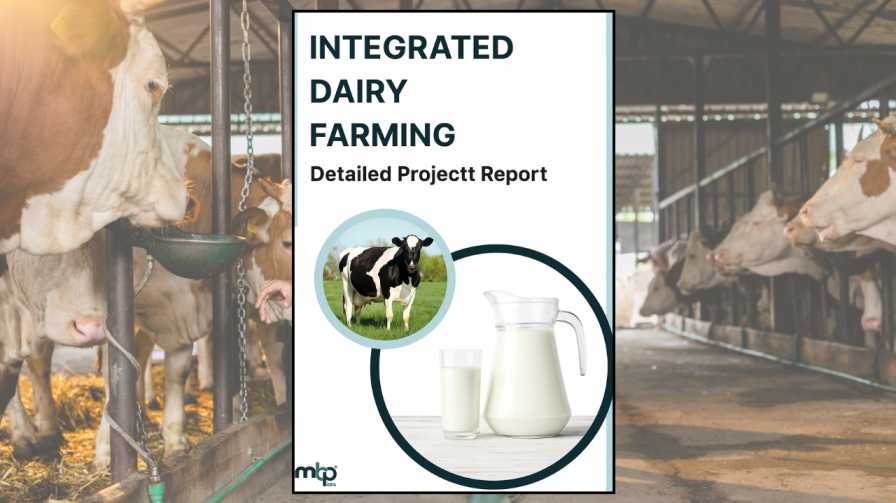
Build a Integrated Dairy Farming line with a bank-ready DPR or fund-ready Business Plan—market & pricing, material routes, process/ops design, compliance/claims guidance, and 5-year financials. Delivery: 12–15 working days.
📄 Download Free Sample Report →
Integrated dairy farming refers to a modern, organized approach to milk production that combines animal husbandry, feed management, breeding, animal health, milk collection, processing support, and waste utilization within a single, well-managed system. Unlike traditional dairy practices that focus only on milk production, integrated dairy farming emphasizes productivity, cost efficiency, quality control, animal welfare, and sustainability. This model enables farmers and enterprises to achieve higher milk yields, consistent quality, and improved profitability.
An integrated dairy farming unit typically includes activities such as scientific cattle selection, balanced feed formulation, mechanized milking, animal healthcare management, cold-chain supported milk handling, and by-product utilization. The system may also integrate fodder cultivation, silage making, biogas generation from dung, and organic manure production, thereby reducing operational costs and improving resource efficiency. Integrated dairy farms are increasingly adopting automation, digital herd management tools, and data-driven decision-making to enhance productivity and traceability.
Dairy farming operations can be broadly classified based on scale and breed. By scale, they include small-scale farms, medium commercial farms, and large industrial dairy units. By breed, farms may focus on indigenous cattle, crossbred cattle, exotic breeds, or buffalo-based dairying depending on regional suitability and market demand. Integrated farms often prefer high-yielding crossbred cows or buffaloes with controlled breeding programs to ensure consistent milk output and quality.
The production process in an integrated dairy farm begins with proper housing and feeding systems, followed by scientific breeding, routine health monitoring, and hygienic milking practices. Milk is immediately cooled using bulk milk coolers to preserve quality before being supplied to processors or cooperatives. Advanced farms use automatic milking machines, herd management software, milk analyzers, and veterinary support systems to ensure efficiency and compliance with food safety standards.
India holds a strong position in dairy farming, being the largest milk producer globally. Integrated dairy farming is gaining momentum in India due to rising demand for milk and dairy products, organized retail expansion, and government support for dairy infrastructure. Increasing consumption of value-added dairy products such as curd, paneer, cheese, butter, and yogurt has further strengthened the role of organized dairy farming systems.
Integrated dairy farming units must comply with animal welfare norms, food safety standards, and environmental regulations. Licensing, veterinary compliance, milk quality standards, and proper waste management practices are essential. Sustainable practices such as water recycling, renewable energy use, and organic manure production are increasingly encouraged.
Growth Drivers
Market Size & Outlook
Global Market:
India Market:
Industry & Market
Demand analysis for milk, curd, paneer, ghee, and dairy by-products.
Consumption trends: urban demand, organized dairy growth, value-added dairy products.
Pricing structure: farm-gate vs processed dairy margins.
Competition overview: local dairies, cooperatives, private players.
Integrated Dairy Model & Product Portfolio
Milk Production: cow/buffalo-based dairy farming.
Feed & Fodder Integration: green fodder cultivation, silage, feed formulation.
Value-Added Products: curd, paneer, ghee, butter, flavored milk.
Manure Management: biogas, organic manure, vermicompost.
Optional Add-ons: calf rearing, breeding services, organic milk branding.
Technical & Operations
Animal breed selection & herd planning.
Housing design: sheds, ventilation, flooring, waste drainage.
Milking systems: manual / semi-automatic / automatic milking parlors.
Feed management & ration balancing.
Water, power, manure, and waste management systems.
Manpower planning & daily operations workflow.
QA/QC & Animal Health
Milk quality parameters: fat %, SNF, bacterial count.
Clean milk production practices.
Vaccination, deworming & veterinary care schedules.
Animal welfare & biosecurity protocols.
Traceability of milk batches.
Compliance & Registrations
Local dairy registration & FSSAI (for processing).
Pollution control & waste management norms.
Animal husbandry department guidelines.
Optional certifications: organic milk, A2 milk (where applicable).
Financial Model (5 Years)
Capital investment: animals, sheds, equipment, fodder systems.
Operating costs: feed, labour, veterinary, utilities.
Milk yield assumptions & revenue streams.
Value-added product margins.
Break-even analysis, cash flow & ROI.
Sensitivity analysis: feed costs, milk price variation.
Implementation Plan
Animal procurement & acclimatization plan.
Shed construction & equipment installation timeline.
Initial herd ramp-up & milk production stabilization.
SOPs for feeding, milking, hygiene & health.
KPIs: milk yield/animal, feed conversion ratio, mortality rate.
Is integrated dairy farming profitable?
Yes. Integration of fodder, milk production, value addition, and manure utilization significantly improves margins and reduces risk.
What is the minimum number of animals required?
Commercial viability typically starts from 10–20 animals, with scalability up to 100+.
Are bank loans and subsidies available?
Yes. The DPR is bank-ready and suitable for NABARD, dairy development schemes, and MSME loans.
How long does it take to break even?
Most integrated dairy projects break even within 2–3 years, depending on scale and value addition.
What are the main risks in dairy farming?
Feed cost fluctuations, animal health issues, milk price variation—addressed through integration and SOPs.
Can value-added products be added later?
Yes. The model supports phased expansion into processing and branding.
Does the DPR include breed and feed planning?
Yes. It includes breed selection, feed formulation, fodder planning, and productivity benchmarks.
No. 401, Pushpak Business Hub, Wakad, Pune, MH 411057
Terms & Conditions | Privacy Policy | Cookie Policy | Disclaimer | © Meticulous Business Plan 2026
Powered by MappedSkills Marketing