₹59,000.00
Build a Tamarind Processing Business line with a bank-ready DPR or fund-ready Business Plan—market & pricing, material routes, process/ops design, compliance/claims guidance, and 5-year financials. Delivery: 12–15 working days.
📄 Download Free Sample Report →
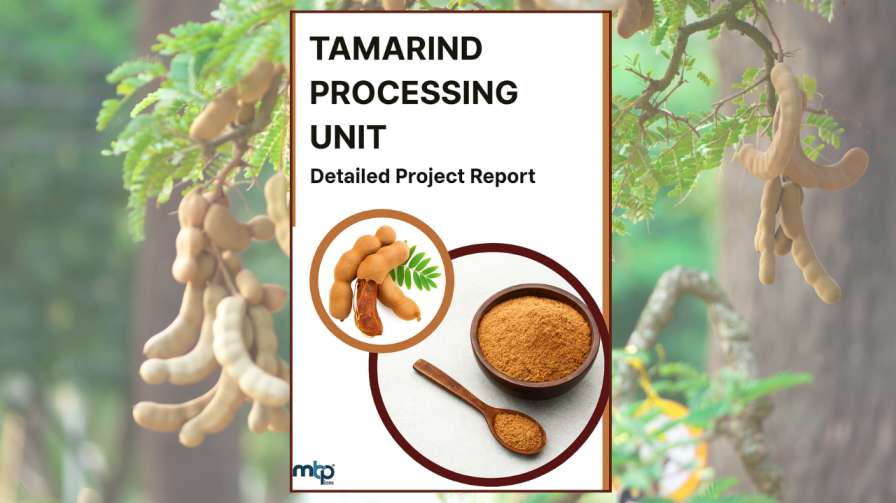
Tamarind processing refers to the conversion of raw tamarind pods into cleaned, deseeded, and value-added products suitable for food, culinary, pharmaceutical, and industrial applications. Tamarind (Tamarindus indica) is a tropical fruit widely known for its distinctive sweet-sour taste, high natural acidity, and rich nutritional profile. Processed tamarind products offer better shelf life, consistent quality, ease of handling, and year-round availability compared to raw tamarind, making them highly preferred in organized food processing and export markets.
Tamarind is extensively used as a natural souring agent, flavor enhancer, and functional ingredient in Indian, Asian, African, and Latin American cuisines. Processed tamarind products are used in sauces, chutneys, curries, ready-to-eat foods, beverages, confectionery, pickles, and seasoning mixes. In addition to food applications, tamarind extracts are used in pharmaceuticals, traditional medicines, and nutraceutical formulations due to their digestive, antioxidant, and medicinal properties.
Tamarind products can be broadly classified based on form and application. By form, the products include wet tamarind pulp, dried tamarind blocks, tamarind paste, tamarind concentrate, spray-dried tamarind powder, and liquid tamarind extracts. By application, tamarind is used in household cooking, food processing industries, horeca, export-oriented food manufacturing, pharmaceuticals, and traditional medicine systems. Tamarind seeds and seed powder are also utilized in textile sizing, paper manufacturing, adhesives, and animal feed applications, enabling complete raw material utilization.
The manufacturing process typically starts with procurement of mature tamarind pods, followed by cleaning, shell breaking, fiber removal, and seed separation. The pulp is refined and processed into paste, concentrate, or powder depending on the target product. Advanced tamarind processing units use pulping machines, vacuum evaporators, spray dryers, and hygienic packaging systems to ensure food safety, uniform acidity, and extended shelf life. Cold processing and aseptic packaging are increasingly adopted for premium and export-grade products.
India is one of the largest producers and exporters of tamarind globally, with strong raw material availability in states such as Tamil Nadu, Andhra Pradesh, Karnataka, and Maharashtra. Growing global demand for ethnic foods, natural souring agents, and clean-label ingredients has significantly increased demand for processed tamarind products. Tamarind’s natural acidity also positions it as a preferred alternative to synthetic food acids in modern food formulations.
Tamarind processing units must comply with food safety and quality regulations. FSSAI registration and labeling compliance are mandatory for domestic sales, while export-oriented units must adhere to international food safety, phytosanitary, and quality standards. Strict hygiene, traceability, moisture control, and quality testing are essential to ensure market acceptance.
Growth Drivers
Global Market:
Indian Market:
Industry & Market
Demand analysis for raw tamarind, seedless tamarind, pulp, paste, concentrate, and powder.
Usage across food processing, chutneys, sauces, beverages, ready-to-cook products.
Domestic vs export demand trends and pricing bands.
Competition mapping and product-grade positioning.
Product Portfolio & Processing Routes
Primary Products: cleaned whole tamarind, seedless tamarind slabs/blocks.
Value-Added Products: tamarind paste, pulp, concentrate, powder.
Industrial/B2B Grades: bulk pulp for sauces, beverages, and FMCG brands.
By-Products: tamarind seed powder, kernel, waste utilization options.
Technical & Operations
Raw tamarind sourcing, grading & drying.
De-shelling, de-seeding, fibre removal.
Pulp extraction & concentration (where applicable).
Drying, grinding & sieving for powder variants.
Packaging systems: pouches, blocks, jars, bulk packs.
Utilities, plant layout, manpower & hygiene zoning.
QA/QC & Specifications
Moisture %, acidity (tartaric acid), colour & flavour.
Microbiological safety and contamination checks.
Shelf-life & storage condition validation.
Packaging integrity and batch traceability.
Compliance & Certifications
FSSAI licensing & food safety norms.
Labeling requirements for retail and bulk products.
HACCP, GMP, ISO 22000 readiness.
Export documentation basics (phytosanitary, COO, test reports).
Financial Model (5 Years)
Capital investment: machinery, utilities, storage.
Operating costs: raw material, labour, power, packaging.
Yield & recovery ratios from raw tamarind.
Revenue projections, break-even & ROI.
Sensitivity analysis for seasonal price fluctuations.
Implementation Plan
Machinery & vendor framework.
Procurement → installation → commissioning timeline.
Trial runs and quality validation.
SOPs, KPIs & governance checklist.
Is tamarind processing a profitable business?
Yes. Tamarind has high shelf life, strong export demand, and multiple value-added product options, making it profitable.
Can this business be started on a small scale?
Yes. Basic de-seeding and block processing requires low capital and can be scaled gradually.
Is tamarind processing seasonal?
Raw tamarind is seasonal, but processing and storage allow year-round sales.
What licenses are required?
An FSSAI license is mandatory. Additional certifications support export and institutional sales.
Is cold storage required?
Not mandatory. Tamarind has natural shelf stability when stored properly.
What markets buy processed tamarind?
Food manufacturers, sauce brands, spice companies, beverage producers, exporters, and wholesalers.
Does the DPR support bank loans and subsidies?
Yes. The DPR is bank-ready and suitable for MSME loans and food-processing subsidy schemes.
No. 401, Pushpak Business Hub, Wakad, Pune, MH 411057
Terms & Conditions | Privacy Policy | Cookie Policy | Disclaimer | © Meticulous Business Plan 2026
Powered by MappedSkills Marketing