
₹59,000.00
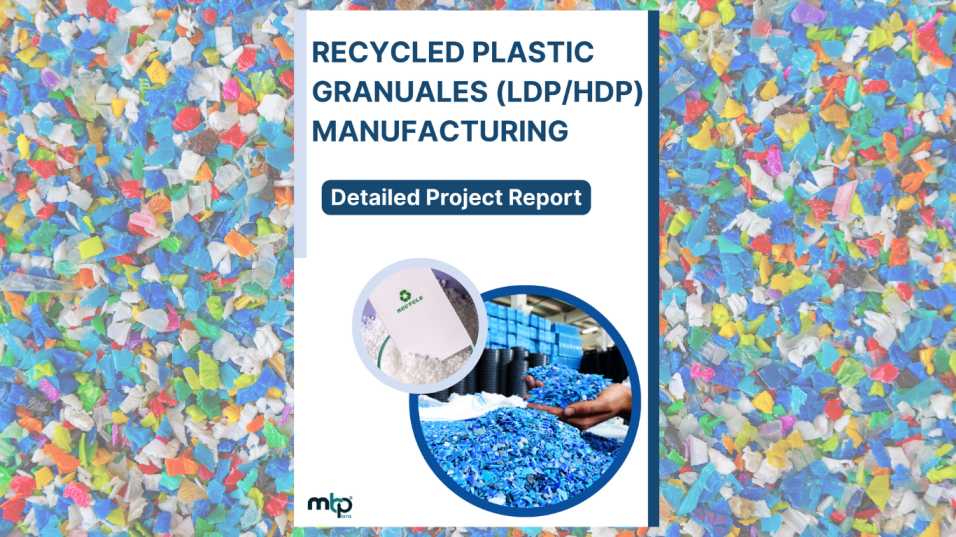
Build an Recycled Plastic Granules Manufacturing line with a bank-ready DPR or fund-ready Business Plan—market & pricing, material routes, process/ops design, compliance/claims guidance, and 5-year financials. Delivery: 12-15 working days
📄 Download Free Sample Report →
Recycled Plastic Granules (LDPE/HDPE) Manufacturing Plant refers to the processing and conversion of plastic waste, scrap, or rejected plastic material into reusable granules that can be used again in plastic product manufacturing. These granules are widely used in the production of packaging items, pipes, films, carry bags, household goods, containers, crates, and industrial plastic components because they offer a cost-effective and sustainable alternative to virgin plastic raw material.
Recycled plastic granules are produced by collecting, sorting, washing, shredding, drying, melting, filtering, and pelletizing plastic waste into uniform granules with controlled melt flow and quality. LDPE and HDPE waste are among the most commonly recycled plastic streams because they are widely available from packaging films, bottles, caps, containers, and industrial scrap. The recycled material is then processed into granules of different grades depending on end-use requirements.
The products can be broadly classified based on polymer type, quality, and application. By polymer type, the category includes LDPE granules, HDPE granules, and mixed recycled granules. By quality, they may be offered as general-purpose granules, film-grade granules, blow-moulding grade granules, or injection-moulding grade granules. This classification allows manufacturers to serve different downstream industries and product segments.
These granules are used extensively in packaging, agriculture, construction, household goods, electrical fittings, industrial moulding, and pipe manufacturing. They are preferred because they are economical, support circular economy practices, reduce environmental waste, and provide a practical alternative to virgin polymers for many non-food applications.
The manufacturing process typically includes raw material collection, sorting, washing, shredding or grinding, drying, extrusion, filtration, pelletizing, cooling, and packaging. Modern plants use automatic washing lines, extruders, pelletizers, separators, and quality control systems to ensure consistency in size, purity, and performance. Proper segregation and cleaning are important because contamination can affect granule quality and end-product performance.
Recycled plastic granules are closely linked to growing environmental regulations, sustainability targets, and rising demand for affordable polymer inputs. India has a large plastic recycling ecosystem supported by industrial demand and expanding waste recovery activity, while global markets continue to promote recycled materials as part of circular manufacturing and plastic reduction initiatives.
Growth Drivers
Market Size & Outlook
Global Market:
India Market:
The project reports provide detailed insights into
Is recycled plastic granules manufacturing profitable?
Yes. Low-cost feedstock, strong industrial demand, and sustainability-driven growth can make it a profitable business.
What are the major end-use sectors?
Packaging, agriculture, construction, household goods, industrial moulding, and pipe manufacturing.
Are bank loans and funding options available?
Yes. The project reports are structured to support MSME loans, term loans, and investor funding proposals.
What approvals are required?
Pollution control approvals, factory license, storage and handling compliance, and local environmental permissions are typically required.
No. 401, Pushpak Business Hub, Wakad, Pune, MH 411057
Terms & Conditions | Privacy Policy | Cookie Policy | Disclaimer | © Meticulous Business Plan 2026
Powered by MappedSkills Marketing