
₹59,000.00
Build a Biomass Carbonation Business line with a bank-ready DPR or fund-ready Business Plan—market & pricing, material routes, process/ops design, compliance/claims guidance, and 5-year financials. Delivery: 12–15 working days.
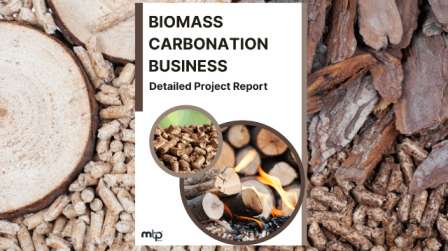
Biomass carbonation is a thermochemical process that converts agricultural residues, forestry waste, and other organic biomass into carbon-rich solid products such as biochar, charcoal, and carbonized biomass. This process enhances the energy density, stability, and carbon content of raw biomass, making it suitable for applications in renewable energy, agriculture, metallurgy, water treatment, and environmental management. Biomass carbonation plays a crucial role in sustainable waste utilization and carbon-neutral energy systems. Carbonated biomass products offer superior calorific value, reduced moisture content, and improved storage stability compared to raw biomass. Biochar produced through controlled carbonation is widely used as a soil amendment to improve soil fertility, water retention, and carbon sequestration, while charcoal and activated carbon are used in fuel, industrial processing, and filtration applications. The ability to convert low-value agricultural waste into high-value carbon products makes biomass carbonation an attractive circular economy solution. The increasing focus on renewable energy, climate change mitigation, and sustainable agriculture has significantly contributed to the rising demand for carbonized biomass products. Governments and industries worldwide are promoting biomass-based alternatives to fossil fuels and chemical-intensive inputs. In India, abundant availability of agricultural residues and increasing policy support for biomass utilization create strong growth potential for biomass carbonation projects. Growth Drivers
Biomass carbonation is a thermochemical process that converts agricultural residues, forestry waste, and other organic biomass into carbon-rich solid products such as biochar, charcoal, and carbonized biomass. This process enhances the energy density, stability, and carbon content of raw biomass, making it suitable for applications in renewable energy, agriculture, metallurgy, water treatment, and environmental management. Biomass carbonation plays a crucial role in sustainable waste utilization and carbon-neutral energy systems.
Carbonated biomass products offer superior calorific value, reduced moisture content, and improved storage stability compared to raw biomass. Biochar produced through controlled carbonation is widely used as a soil amendment to improve soil fertility, water retention, and carbon sequestration, while charcoal and activated carbon are used in fuel, industrial processing, and filtration applications. The ability to convert low-value agricultural waste into high-value carbon products makes biomass carbonation an attractive circular economy solution.
The increasing focus on renewable energy, climate change mitigation, and sustainable agriculture has significantly contributed to the rising demand for carbonized biomass products. Governments and industries worldwide are promoting biomass-based alternatives to fossil fuels and chemical-intensive inputs. In India, abundant availability of agricultural residues and increasing policy support for biomass utilization create strong growth potential for biomass carbonation projects.
Growth Drivers
Market Size & Outlook
Global Market:
The project reports provide detailed insights into:
These reports offer a comprehensive feasibility analysis along with suitable business models and structured implementation plans.
Kick-off (optional) — 45-min Expert Call add-on to align tech route, yields, and channel focus.
Research & Modeling — Market, CEA ops blueprint, and financials tailored to your plan.
Draft Delivery — Review together; 1st revision free.
Final Handover — DPR/Business Plan PDF (and Editable Files if selected).
DPR: ₹59,000 — Delivery: 12–15 working days
Business Plan: ₹59,000 — Delivery: 12–15 working days
Add-ons: Customization ₹3,500 · Expert Call ₹2,500 · Editable Files ₹4,500 · Extra Revisions ₹1,500 (first revision free)
Delivery Mode: Secure email/download link. Support: Email for clarifications.
Is biomass carbonation a viable business?
Yes. The business benefits from multiple end-use industries, strong sustainability drivers, and increasing demand for renewable and carbon-negative products.
What are the major end-use industries?
Agriculture (biochar), renewable energy, metallurgy, water treatment, air filtration, and industrial fuel applications.
Are bank loans and funding options available?
Yes. The project reports are bank-ready and suitable for MSME loans, green financing, and sustainability-linked funding.
What approvals are required?
Environmental clearance, pollution control approvals, local authority permissions, and compliance with waste handling and emission norms are required depending on project scale.

No. 401, Pushpak Business Hub, Wakad, Pune, MH 411057
Terms & Conditions | Privacy Policy | Cookie Policy | Disclaimer | © Meticulous Business Plan 2026
Powered by MappedSkills Marketing