
Starting a business is exciting, but many ventures fail not because the idea is bad, but because the business model is weak. A strong product, talented team, and sufficient funding are important—but the real driver of sustainable success is a well-designed business model.
Business modelling helps entrepreneurs understand how a company creates value, delivers it to customers, and generates revenue. Without this clarity, even innovative ideas struggle to survive in competitive markets.
In this guide, we will explore what business modelling is, why it matters, key components of a strong business model, and real-world examples of companies that transformed industries through business model innovation.
Business modelling is the process of designing, analysing, and structuring how a business operates and makes money.
A business model explains:
Management expert Peter Drucker famously summarised the essence of business strategy into three core questions:
Answering these questions forms the foundation of a successful business model.
1. Provides Strategic Clarity
Business modelling helps entrepreneurs translate ideas into a workable strategy.
Instead of guessing, founders can evaluate different possibilities such as:
This process reduces risk and improves decision-making.
2. Helps Attract Investors
Investors rarely fund ideas alone—they fund sustainable business models.
A well-defined business model shows that the entrepreneur understands:
Before analysing financial projections, investors typically review whether the business model itself is viable.
3. Builds Competitive Advantage
In many industries, the business model itself becomes the innovation.
Companies can differentiate themselves not only through products but through how they deliver value.
Examples include:
A unique business model can help companies stand out even in crowded markets.
4. Guides Operational Decisions
A business model influences daily business activities such as:
It acts as a roadmap for both strategy and execution.

One of the most powerful examples of business model innovation is Netflix.
Phase 1: DVD-by-Mail Model (1997–2007)
When Netflix launched, the video rental industry was dominated by Blockbuster.
Instead of competing with physical stores, Netflix created a subscription-based DVD-by-mail service.
Customers could:
This approach focused on customer convenience and predictable revenue, disrupting the traditional rental model.
Phase 2: Streaming Platform (2007–Present)
As internet speeds improved, Netflix anticipated the future of digital entertainment.
The company invested heavily in:
Today Netflix operates globally with hundreds of millions of subscribers, proving how adapting the business model can redefine an industry.
A comprehensive business model includes several interconnected elements.
The value proposition explains why customers should choose your product or service.
It answers:
Clearly defining your target audience is crucial.
Examples include:
The more specific the segment, the easier it becomes to design a strong offering.
Revenue streams describe how the business earns money.
Common examples include:
Understanding costs ensures long-term profitability.
Typical business costs include:
These are the core activities required to operate the business.
For example:
Businesses rely on critical resources such as:
Distribution channels determine how products reach customers.
Examples include:
Customer relationship strategies focus on:
Strategic partnerships strengthen business models by providing:
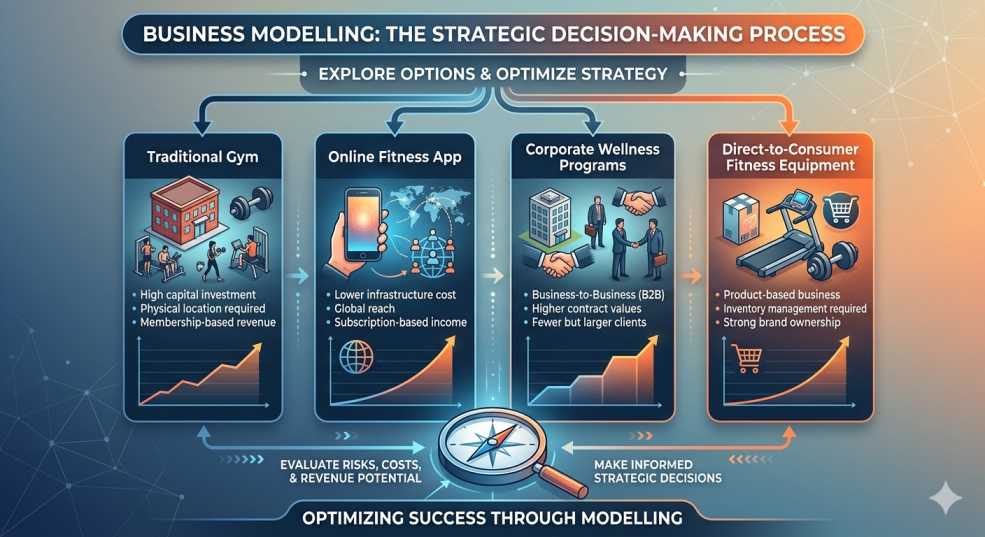
One powerful benefit of business modelling is the ability to explore multiple strategic options before investing heavily.
Consider a fitness business idea. It could be structured in several ways:
Traditional Gym
Online Fitness App
Corporate Wellness Programs
Direct-to-Consumer Fitness Equipment
Each model serves the same market need but operates with different economics and growth potential.
Markets change quickly. Technology evolves. Customer expectations shift.
Companies that fail to adapt risk becoming irrelevant.
Successful organisations regularly ask:
Regular review helps businesses stay competitive and resilient in dynamic markets.
A great idea alone does not build a successful company.
What truly determines success is how the business is structured to create and capture value.
Business modelling helps entrepreneurs:
Whether you are launching a startup, expanding an existing business, or exploring a new opportunity, investing time in designing a robust business model can significantly improve your chances of long-term success.
Because successful companies are not just built on ideas—they are built on systems designed to win.
No. 401, Pushpak Business Hub, Wakad, Pune, MH 411057
Terms & Conditions | Privacy Policy | Cookie Policy | Disclaimer | © Meticulous Business Plan 2026
Powered by MappedSkills Marketing