
₹59,000.00
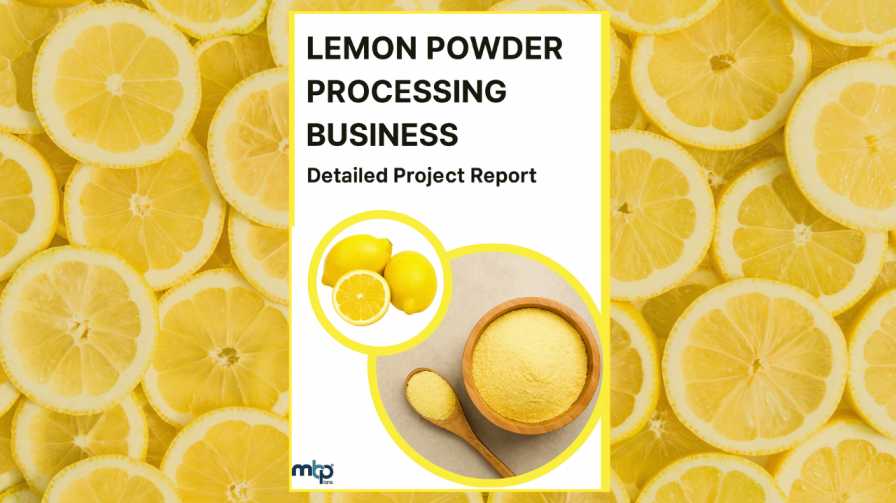
Build a Lemon Powder Processing line with a bank-ready DPR or fund-ready Business Plan—market & pricing, material routes, process/ops design, compliance/claims guidance, and 5-year financials. Delivery: 12–15 working days.
📄 Download Free Sample Report →
Lemon powder processing refers to the conversion of fresh lemons into a dehydrated, free-flowing powder while retaining the fruit’s natural acidity, flavor, aroma, and functional properties. Lemon powder is a versatile food ingredient widely used as a natural flavoring, acidulant, and nutritional enhancer across food, beverage, nutraceutical, pharmaceutical, and cosmetic applications. It offers the advantages of longer shelf life, ease of storage, consistent quality, and year-round availability compared to fresh lemons.
Lemon powder is produced from whole lemons or lemon juice concentrate using controlled drying technologies that minimize nutrient loss, especially vitamin C and natural citric acid. The product delivers the characteristic sour taste and citrus notes of fresh lemon and is commonly used in instant beverages, seasoning blends, bakery mixes, confectionery, soups, sauces, marinades, health supplements, and functional foods. Due to its natural origin, lemon powder is increasingly preferred over synthetic citric acid in clean-label and natural product formulations.
Lemon powder can be broadly classified based on processing method and application. By processing type, it includes spray-dried lemon powder (from juice or concentrate), drum-dried lemon powder, and freeze-dried lemon powder. By application, it is used in food and beverages, nutraceuticals, pharmaceuticals, cosmetics, and household products. Food-grade lemon powder is the most widely consumed segment, while nutraceutical and cosmetic grades focus on higher purity and functional consistency.
The manufacturing process generally involves selection of mature lemons, washing and sorting, juice extraction or slicing, filtration, concentration (if required), drying, milling, sieving, and hygienic packaging. Advanced processing units use spray dryers, vacuum dryers, or freeze dryers to preserve color, aroma, and nutritional value. Anti-caking agents may be added in minimal quantities to improve flow properties depending on end-use requirements. Strict quality control is essential to ensure uniform acidity, moisture content, microbial safety, and compliance with food standards.
India has strong potential for lemon powder processing due to wide cultivation of lemons and citrus fruits across multiple states. The growing demand for natural flavoring agents, instant food products, and functional beverages has accelerated domestic consumption. Export demand for lemon powder is also rising in markets seeking natural citrus ingredients for clean-label food and beverage formulations.
Lemon powder processing units must comply with food safety and quality regulations. FSSAI registration and labeling compliance are mandatory for domestic sales, while export-oriented units must adhere to international food safety standards. Proper hygiene, traceability, and moisture-controlled packaging are critical to ensure product stability and market acceptance.
Growth Drivers
Market Size & Outlook
Global Market:
India Market:
Industry & Market
Demand for lemon powder in food seasoning, beverages, bakery, ready-to-eat foods, nutraceuticals, and cosmetics.
Growth drivers: convenience foods, clean-label ingredients, long shelf-life products.
Market segmentation: domestic retail, B2B food manufacturers, horeca, exports.
Pricing bands, quality grades, and competition overview.
Product Portfolio & Processing Routes
Dehydrated Lemon Powder (whole fruit / peel / juice solids).
Spray-Dried Lemon Powder (industrial & beverage-grade).
Flavoured & Functional Blends (lemon-ginger, lemon-mint, vitamin-C enriched).
By-Products: lemon peel powder, fibre, essential oil extraction (optional).
Technical & Operations
Raw lemon sourcing, grading & washing.
Slicing / juice extraction / peel separation.
Dehydration methods: tray dryer, tunnel dryer, freeze drying, spray drying.
Milling, sieving & blending.
Packaging: pouches, jars, bulk bags.
Utilities, plant layout, manpower & hygiene zoning.
QA/QC & Specifications
Moisture %, particle size, colour & flavour retention.
Acidity (citric acid content) & solubility.
Microbial safety & shelf-life testing.
Packaging integrity & batch traceability.
Compliance & Certifications
FSSAI licensing & food safety norms.
Labeling requirements (ingredients, acidity, nutritional values).
HACCP, GMP, ISO 22000 readiness.
Export documentation basics for dehydrated fruit products.
Financial Model (5 Years)
Capital investment (dryers, pulverizers, utilities).
Operating costs (raw lemons, power, labour, packaging).
Yield & conversion ratios.
Revenue, profitability & break-even analysis.
Sensitivity analysis for lemon price seasonality & power costs.
Implementation Plan
Machinery & vendor framework.
Procurement → installation → commissioning timeline.
Trial runs & quality validation.
KPIs, SOPs & governance checklist.
Is lemon powder a profitable business?
Yes. Lemon powder offers long shelf life, low storage loss, and high B2B demand, making it a profitable value-addition business.
Can I start this business on a small scale?
Yes. The project can start with low-capex dehydration setups and scale to spray drying or exports later.
What raw material quality is required?
Fresh, mature lemons with good acidity are preferred; grade-B fruits are also suitable, reducing raw material cost.
Is cold storage required?
Not mandatory. Dehydration reduces spoilage, but short-term storage of fresh lemons may be required.
What licenses are needed?
An FSSAI license is mandatory. Additional certifications help in export and institutional sales.
What industries buy lemon powder?
Food processors, beverage companies, spice brands, bakeries, nutraceutical firms, cosmetics, and exporters.
Does the DPR support bank loans and subsidies?
Yes. The DPR is bank-ready and suitable for MSME loans and food-processing subsidy schemes.
No. 401, Pushpak Business Hub, Wakad, Pune, MH 411057
Terms & Conditions | Privacy Policy | Cookie Policy | Disclaimer | © Meticulous Business Plan 2026
Powered by MappedSkills Marketing