₹59,000.00
Set up a Jackfruit Processing unit with a bank-ready DPR or fund-ready Business Plan. Includes market sizing, pricing & channels, materials/process design, compliance & labeling, and 5-year financials. Delivery: 12–15 working days.
📄 Download Free Sample Report →
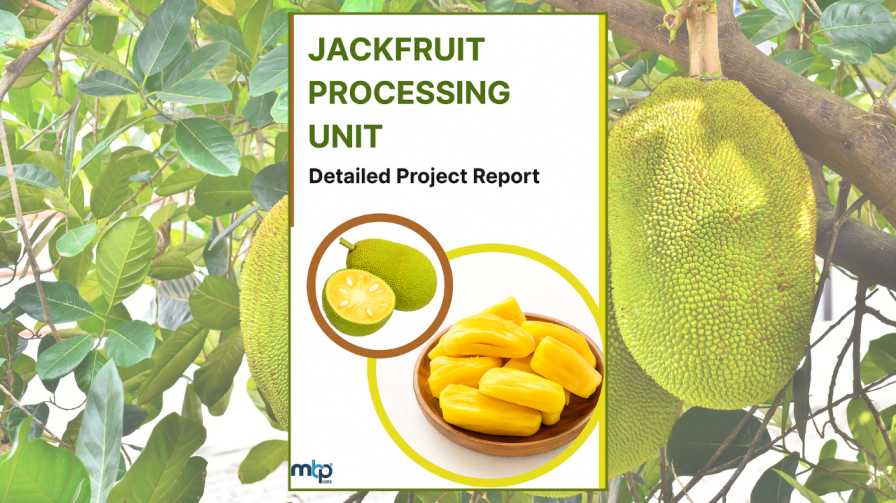
Jackfruit processing refers to the conversion of raw and ripe jackfruit into a range of value-added food products through hygienic and controlled processing methods while preserving nutritional value, texture, and shelf stability. Jackfruit (Artocarpus heterophyllus) is a highly nutritious tropical fruit known for its high dietary fiber, carbohydrates, potassium, antioxidants, and bioactive compounds. Due to its fibrous texture and neutral taste in raw form, jackfruit has gained global recognition as a plant-based meat alternative, while ripe jackfruit is widely consumed in sweet and beverage applications.
Jackfruit processing is broadly classified based on maturity stage and product form. Raw or tender jackfruit is processed into frozen cubes, canned products, curry bases, ready-to-cook meals, and plant-based meat substitutes. Ripe jackfruit is processed into pulp, juice, concentrates, jams, dehydrated slices, chips, powders, and bakery fillings. Jackfruit seeds are also processed into flour and snack products, improving overall fruit utilization and reducing processing waste.
The manufacturing process typically includes fruit reception, cleaning, peeling, cutting, seed separation, blanching, pulping, drying, freezing, or thermal processing depending on the end product. Advanced processing units may incorporate IQF freezing, vacuum drying, freeze drying, retort processing, and extrusion technology for plant-based meat products. Hygienic handling, cold chain management, and food-grade packaging are critical to maintain product quality and meet domestic and export standards.
Jackfruit processed products are widely used in ready-to-eat meals, frozen foods, vegan and vegetarian meat alternatives, bakery and confectionery products, beverages, desserts, institutional catering, and export markets. Its growing acceptance among health-conscious consumers, vegans, and sustainability-focused food brands has significantly expanded its commercial potential. India holds a strong advantage in jackfruit processing due to abundant raw material availability, varietal diversity, and increasing government support for fruit processing and value addition.
Growth Drivers
Market Size & Outlook
Global Market:
India Market:
The India Jackfruit Market size was USD 230.23 Million in 2024 and is projected to reach USD 376.72 Million by 2033 at a CAGR of 5.57%.
Industry & Market
Demand analysis for raw, tender, and ripe jackfruit products.
Growth in plant-based meat alternatives, vegan foods, and export demand.
Market segments: retail, HORECA, institutional buyers, exports.
Pricing bands, competition mapping, and product positioning.
Product Portfolio & Processing Routes
Tender Jackfruit Products: frozen cubes, vacuum-packed, canned, ready-to-cook.
Ripe Jackfruit Products: pulp, frozen bulbs, chips, dehydrated slices, jams.
Value-Added Products: jackfruit meat substitutes, curry cuts, flour, sweets.
By-product Utilization: seeds (flour, roasted snacks), fibre, waste management.
Technical & Operations
Raw jackfruit procurement & grading.
Cutting, cleaning, blanching, and pre-treatment.
Processing routes: freezing, dehydration, canning, vacuum packing.
Packaging systems: pouches, cans, trays, bulk packs.
Utilities, plant layout, cold storage, manpower & hygiene zoning.
QA/QC & Specifications
Quality parameters: moisture, texture, colour, flavour.
Microbiological safety & shelf-life testing.
Packaging integrity & cold-chain checks.
Batch traceability & production documentation.
Compliance & Certifications
FSSAI licensing and food safety norms.
Labeling requirements & allergen declarations.
HACCP, GMP, ISO 22000 readiness.
Export documentation basics for processed fruits.
Financial Model (5 Years)
Capital investment (machinery, cold storage, utilities).
Operating costs (raw material, labour, power, packaging).
Yield assumptions for tender & ripe jackfruit.
Revenue projections, break-even & ROI.
Sensitivity analysis for raw material seasonality & pricing.
Implementation Plan
Machinery & packaging vendor framework.
Procurement → installation → commissioning timeline.
Trial runs & pilot batch planning.
KPIs, SOPs, and governance checklist.
Which plan should I choose — DPR or Business Plan?
Choose DPR for feasibility + lender/subsidy documentation. Choose Business Plan for GTM, channels, and investor narrative. Many clients opt for both.
Is jackfruit processing a profitable business?
Yes. Jackfruit has low raw material cost, high yield, and growing demand in vegan, export, and ready-to-cook segments, making it a high-potential business.
Do I need cold storage for jackfruit processing?
Cold storage is recommended for tender jackfruit and frozen products but not mandatory for dehydration or canning-based models.
What licenses are required?
An FSSAI license is mandatory. Additional registrations may be needed for exports or certifications like HACCP or ISO 22000.
Can this project be financed through bank loans or subsidies?
Yes. The DPR is bank-ready and suitable for MSME loans, PMFME, and state food processing schemes.
Is this business seasonal?
Jackfruit is seasonal, but processing, freezing, dehydration, and pulp storage allow year-round sales.
Can I start on a small scale?
Yes. The project can be started with low-capex semi-automatic setups and scaled gradually.
Does the DPR include machinery details?
Yes. It includes process flow, machinery list, utilities, layout, and capacity planning.


No. 401, Pushpak Business Hub, Wakad, Pune, MH 411057
Terms & Conditions | Privacy Policy | Cookie Policy | Disclaimer | © Meticulous Business Plan 2026
Powered by MappedSkills Marketing