
₹59,000.00
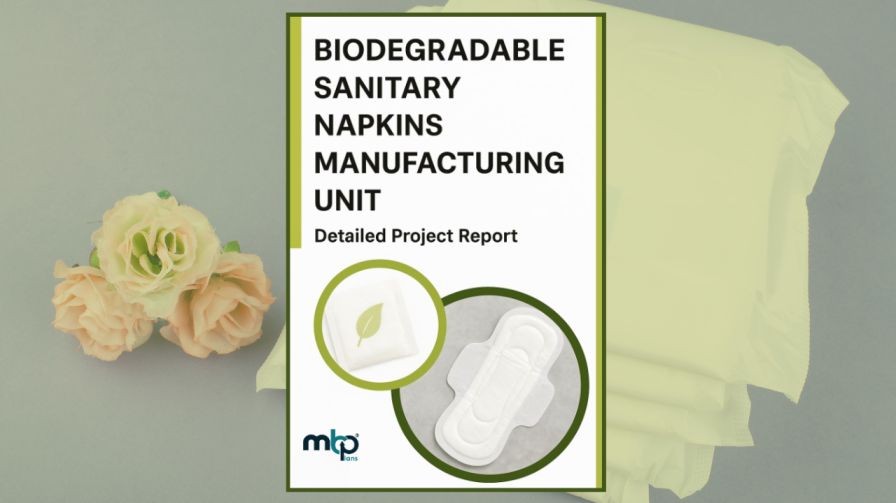
Set up a Biodegradable Sanitary Napkins unit with a bank-ready DPR or fund-ready Business Plan. Includes market sizing, pricing & channels, materials/process design, compliance & labeling, and 5-year financials. Delivery: 12–15 working days.
Biodegradable sanitary napkins manufacturing refers to the production of eco-friendly menstrual hygiene products made from natural, compostable, and biodegradable raw materials such as banana fiber, bamboo fiber, corn starch–based biopolymers, cellulose pulp, organic cotton, and biodegradable back sheets. Unlike conventional sanitary napkins that contain plastic layers and synthetic absorbents, biodegradable sanitary napkins decompose naturally within a few months, significantly reducing environmental pollution and landfill burden.
Biodegradable sanitary napkins are designed to provide effective menstrual protection while being safe for the human body and the environment. These products offer high absorbency, breathability, skin comfort, and protection against leakage, making them suitable for daily use. They are widely used in household consumption, institutional supply programs, rural health initiatives, schools, colleges, NGOs, hospitals, and government-supported menstrual hygiene schemes.
The product range includes ultra-thin pads, regular pads, night pads, panty liners, maternity pads, and reusable or partially biodegradable variants. Based on usage, products are categorized into daytime use, nighttime use, and heavy-flow protection.
Manufacturing involves fiber processing, absorbent core formation, layering, sealing, sterilization, quality inspection, and hygienic packaging. Semi-automatic and fully automatic sanitary napkin machines are used depending on production capacity. Advanced technologies focus on chlorine-free processing, odor control, high absorbency cores, and breathable back sheets. Production units are required to maintain strict hygiene standards and controlled environments to ensure product safety and quality.
Growth Drivers
Market Size & Outlook
Global Market:
India Market:
Option A — Detailed Project Report (DPR) (bank-ready feasibility)
Industry & Market: growth drivers (sustainability, health awareness), urban/rural & e-commerce demand, price bands & pack sizes (day/night/XL).
Positioning & Competition: eco claims (biodegradable/compostable), private label vs brand, packaging cues.
Materials & BOM choices:
Topsheet: bamboo/organic-cotton nonwoven or PLA-based nonwoven.
Acquisition/Distribution layer: tissue/cellulose web.
Absorbent core: fluff pulp with bio-based SAP alternatives (or low-SAP blended approach as chosen).
Backsheet: breathable compostable film (PLA/starch blend).
Wings & leak guards: biodegradable nonwoven + elastic options.
Adhesives & release liners: hot-melt; compostable release where feasible.
Wrap & outer pack: paper/compostable film options.
Process & Operations: multi-unwind, core forming & embossing, dosing, lamination (ultrasonic/adhesive), wing cutting, edge sealing, inline QC, UV treatment/sterilization step (as applicable), stacking & packaging; utilities, layout & manpower.
QA/QC & Specs: absorbency/retention, strike-through, re-wet, tensile/peel, fit & dimensions, pH/odor checks, basic microbiology; labeling checklist for hygiene products and environmental claims substantiation.
Financial Model (5 years): capex/opex by section, throughput & yields, break-even, cash flow, sensitivity (pulp price, film cost, realization, power).
Compliance & Risk: quality & safety benchmarks for sanitary napkins, packaging/label declarations, guidance on third-party biodegradability/compostability testing for claim support, waste-handling considerations; risk mitigations (supply variability, claim compliance, QC drift).
Implementation Plan: procurement & erection timeline, pilot/validation runs, KPIs, SOPs, governance.
Option B — Business Plan (strategy & fundraising)
Company & Offering: SKU architecture (day/night/ultra-thin/maternity), pricing ladders, claims & messaging.
GTM & Channels: D2C site & subscriptions, marketplaces, modern retail/pharmacies, NGOs/institutional programs; distributor model & SLAs.
Operations & Team: vendor strategy (nonwovens, films, adhesives), inventory norms, packaging choices, org & hiring roadmap.
Financial Forecasts (3–5 years): unit economics, P&L, cash flow, scenarios.
Growth & Risk Plan: capacity ramp-up, private label contracts, export readiness, mitigations.
Format: PDF (print-ready). Editable Files available as add-on.
Is biodegradable sanitary napkins manufacturing a viable business?
Yes. Strong demand driven by sustainability, hygiene awareness, and policy support ensures long-term growth and scalability.
Which plan should I choose — DPR or Business Plan?
Choose DPR for feasibility + lender/subsidy documentation. Choose Business Plan for GTM, channels, and investor narrative. Many clients opt for both.
What are the major end-use sectors?
Household consumers, government supply programs, schools, NGOs, hospitals, pharmacies, and export markets.
Are bank loans and funding options available?
Yes. The project reports are structured to support MSME loans, women entrepreneurship schemes, and impact investment funding.
What approvals are required?
Factory license, pollution control approvals, product safety compliance, hygiene standards adherence, and applicable BIS/FSSAI guidelines.

No. 401, Pushpak Business Hub, Wakad, Pune, MH 411057
Terms & Conditions | Privacy Policy | Cookie Policy | Disclaimer | © Meticulous Business Plan 2026
Powered by MappedSkills Marketing