
₹59,000.00
Build a Needle Syringes Catheters Cannula & IV Sets Manufacturing line with a bank-ready DPR or fund-ready Business Plan—market & pricing, material routes, process/ops design, compliance/claims guidance, and 5-year financials. Delivery: 12–15 working days.
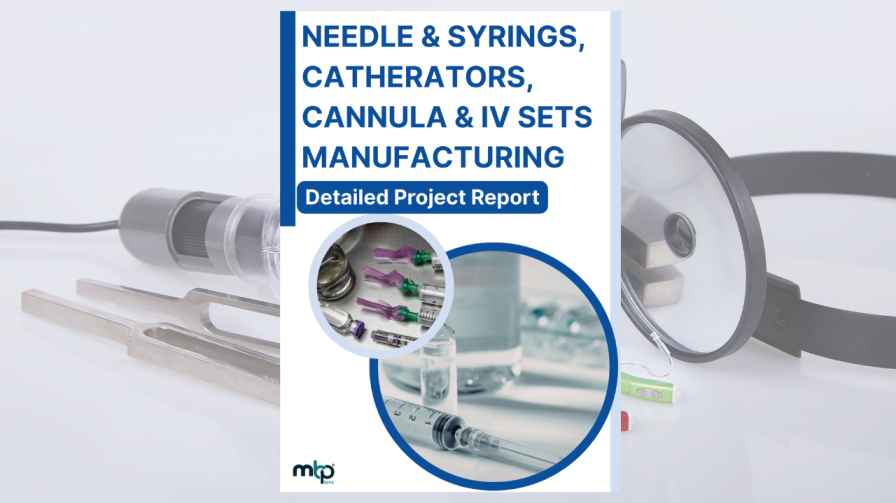
Needle, syringe, catheter, cannula, and IV set manufacturing refers to the production of sterile, single-use medical disposables used for drug delivery, fluid infusion, blood collection, and various diagnostic and therapeutic procedures. These products form the backbone of modern healthcare delivery and are used across hospitals, clinics, diagnostic centers, emergency care units, ambulatory surgical centers, and home healthcare settings. Due to their direct contact with the human body, medical disposables are manufactured under highly regulated conditions to ensure safety, sterility, precision, and consistent performance. The product range includes hypodermic needles, disposable syringes (insulin syringes, auto-disable syringes, standard syringes), IV cannulas, scalp vein sets, infusion sets, urinary catheters, and related tubing accessories. Based on application, these products are used for injections, vaccinations, intravenous therapy, blood transfusion, anesthesia delivery, dialysis, urinary drainage, and critical care monitoring. The increasing preference for single-use medical devices to prevent hospital-acquired infections has significantly strengthened demand across healthcare systems. Manufacturing involves precision engineering and strict quality control. Core processes include medical-grade polymer processing, stainless steel needle fabrication, injection molding, automated assembly, sterilization, and tamper-proof packaging. Technologies such as high-speed injection molding machines, automated needle grinding and beveling systems, robotic assembly lines, and sterilization methods like ethylene oxide (ETO) and gamma irradiation are widely used. Production is carried out in controlled cleanroom environments to comply with international medical device standards. India has become a global manufacturing hub for medical disposables due to cost-efficient production, skilled manpower, expanding healthcare infrastructure, and compliance with global certifications such as ISO 13485, CE marking, and US FDA standards. Government initiatives promoting domestic medical device manufacturing and export-oriented production have further strengthened the growth outlook for this sector. Growth Drivers
Needle, syringe, catheter, cannula, and IV set manufacturing refers to the production of sterile, single-use medical disposables used for drug delivery, fluid infusion, blood collection, and various diagnostic and therapeutic procedures. These products form the backbone of modern healthcare delivery and are used across hospitals, clinics, diagnostic centers, emergency care units, ambulatory surgical centers, and home healthcare settings. Due to their direct contact with the human body, medical disposables are manufactured under highly regulated conditions to ensure safety, sterility, precision, and consistent performance.
The product range includes hypodermic needles, disposable syringes (insulin syringes, auto-disable syringes, standard syringes), IV cannulas, scalp vein sets, infusion sets, urinary catheters, and related tubing accessories. Based on application, these products are used for injections, vaccinations, intravenous therapy, blood transfusion, anesthesia delivery, dialysis, urinary drainage, and critical care monitoring. The increasing preference for single-use medical devices to prevent hospital-acquired infections has significantly strengthened demand across healthcare systems.
Manufacturing involves precision engineering and strict quality control. Core processes include medical-grade polymer processing, stainless steel needle fabrication, injection molding, automated assembly, sterilization, and tamper-proof packaging. Technologies such as high-speed injection molding machines, automated needle grinding and beveling systems, robotic assembly lines, and sterilization methods like ethylene oxide (ETO) and gamma irradiation are widely used. Production is carried out in controlled cleanroom environments to comply with international medical device standards.
India has become a global manufacturing hub for medical disposables due to cost-efficient production, skilled manpower, expanding healthcare infrastructure, and compliance with global certifications such as ISO 13485, CE marking, and US FDA standards. Government initiatives promoting domestic medical device manufacturing and export-oriented production have further strengthened the growth outlook for this sector.
Growth Drivers
Market Size & Outlook
Global Market:
India Market:
The project reports provide detailed insights into:
These reports offer a comprehensive feasibility analysis with structured business models and implementation strategies.
DPR: ₹59,000 — Delivery: 12–15 working days
Business Plan: ₹59,000 — Delivery: 12–15 working days
Add-ons: Customization ₹3,500 · Expert Call ₹2,500 · Editable Files ₹4,500 · Extra Revisions ₹1,500 (first revision free)
Delivery Mode: Secure email/download link. Support: Email for clarifications.
Is needle and syringe manufacturing a viable business?
Yes. Continuous demand from healthcare systems, immunization programs, and exports ensures long-term stability and scalability.
What are the major end-use sectors?
Hospitals, clinics, diagnostic centers, vaccination programs, home healthcare, and export markets.
Are bank loans and funding options available?
Yes. The project reports are structured to support MSME loans, term loans, and investor funding proposals.
What approvals are required?
CDSCO registration, ISO 13485 certification, pollution control approvals, sterilization validation, and applicable export certifications.
No. 401, Pushpak Business Hub, Wakad, Pune, MH 411057
Terms & Conditions | Privacy Policy | Cookie Policy | Disclaimer | © Meticulous Business Plan 2026
Powered by MappedSkills Marketing