
Government Support for Food and Agri Businesses in India: Policies, Schemes & Opportunities (Complete Guide)
India’s food and agriculture sector offers massive opportunities for entrepreneurs, startups, and investors. With increasing demand for processed food, improved supply chains, and rising exports, the sector is becoming one of the fastest-growing business opportunities in India.
To promote growth, the Government of India has introduced several policies, subsidies, and financial schemes that support food processing units, agri startups, cold storage infrastructure, and value-added agricultural businesses.
This guide explains how the government supports food and agri businesses in India, major policies and schemes available, and practical examples of how entrepreneurs can benefit from them.
Agriculture is the backbone of India’s economy. The government actively supports food and agri businesses to achieve several national goals:
Government initiatives led by organizations such as Ministry of Food Processing Industries and Ministry of Agriculture and Farmers Welfare aim to transform agriculture from raw commodity supply to high-value processing and export industries.
The government encourages entrepreneurs to establish food processing industries that convert agricultural produce into value-added products.
Key focus areas include:
Programs implemented by the Ministry of Food Processing Industries help reduce post-harvest wastage and improve farmers’ market access.
Agricultural infrastructure plays a crucial role in improving the supply chain. To address infrastructure gaps, the government launched the Agriculture Infrastructure Fund.
Key features include:
This scheme helps entrepreneurs establish facilities such as:
The PM Formalisation of Micro Food Processing Enterprises Scheme supports small food processing entrepreneurs and micro-enterprises.
Key Benefits
This scheme is especially beneficial for home-based food businesses and small processing units.
The Pradhan Mantri Kisan Sampada Yojana aims to create modern food processing infrastructure.
Supported Projects
This scheme promotes large-scale investment in food processing industries.
Entrepreneurs launching agri-tech businesses can benefit from the Startup India program supported by NITI Aayog.
Benefits
This program supports innovation in areas such as:
The Agriculture Infrastructure Fund provides financing support for agriculture infrastructure projects.
Eligible Projects
Entrepreneurs can receive interest subsidies and financial assistance, making infrastructure development more affordable.
To understand how these schemes work in practice, consider an entrepreneur planning to start a mango pulp processing unit.
Step 1: Business Planning
The entrepreneur prepares a Detailed Project Report (DPR) including:
Step 2: Applying for Government Subsidy
The entrepreneur applies under the PM Formalisation of Micro Food Processing Enterprises Scheme.
Benefits received include:
Step 3: Infrastructure Financing
For building processing infrastructure and cold storage, the entrepreneur uses funding from the Agriculture Infrastructure Fund.
This helps reduce loan interest rates and improves project viability.
Step 4: Market Expansion
With government support, the business can expand into:
This creates higher value for agricultural produce and increases farmers’ income.
Government initiatives also promote several related business opportunities.
Farmers and entrepreneurs receive support for organic certification and organic farming promotion.
Financial assistance is provided for refrigerated storage and transportation systems to reduce food wastage.
Export promotion is supported through organizations such as Agricultural and Processed Food Products Export Development Authority.
This helps Indian food businesses access global markets.
Government-backed incubators support technology-based agricultural startups developing solutions for:
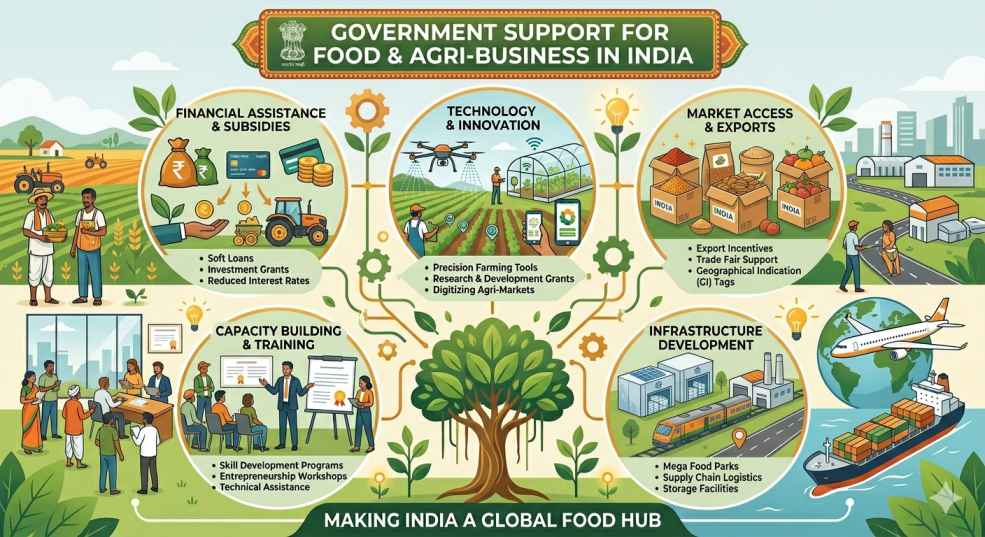
Government programs help food and agri entrepreneurs by providing:
These benefits significantly reduce financial risk and encourage investment in the agriculture sector.
The food and agriculture sector in India offers tremendous opportunities for entrepreneurs, startups, and investors.
With strong government policies, financial incentives, and infrastructure development programs, starting a food processing or agri-based business has become more accessible than ever.
Entrepreneurs who understand and leverage government schemes can build profitable businesses while contributing to rural development, food security, and economic growth.
No. 401, Pushpak Business Hub, Wakad, Pune, MH 411057
Terms & Conditions | Privacy Policy | Cookie Policy | Disclaimer | © Meticulous Business Plan 2026
Powered by MappedSkills Marketing