
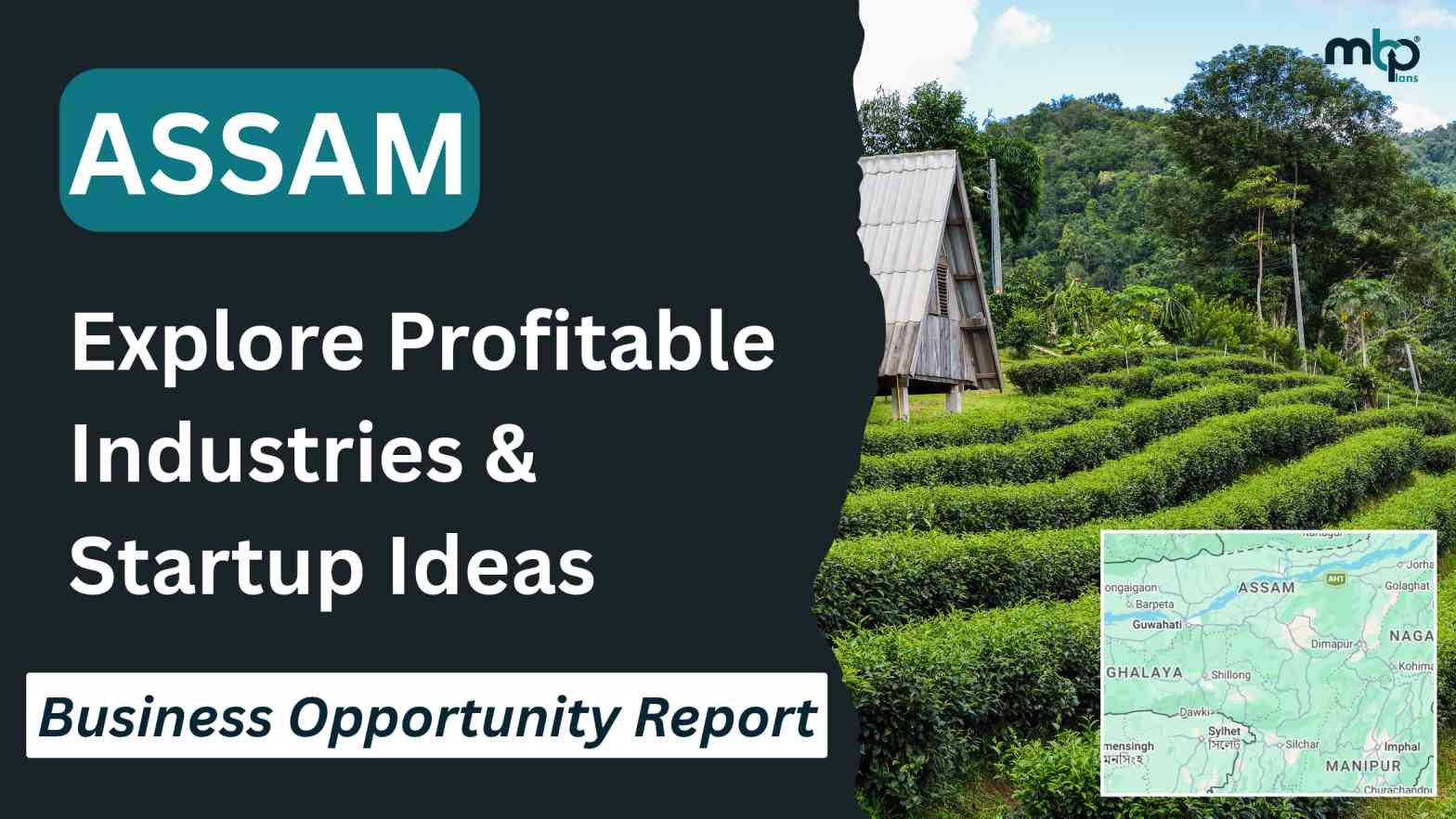
How the Northeast’s biggest economy is building on its tea legacy, a new chip-packaging plant, and a push for tourism and clean energy – and where the real openings are for entrepreneurs right now.
Assam has been India’s tea heartland for nearly two centuries, and that identity still defines the state. But in 2026 the story is getting bigger. A ₹27,000 crore semiconductor plant is moving toward full operation, the state government is courting investors across manufacturing, logistics, energy, and tourism, and a wave of small founders is turning local resources like tea, Muga and Eri silk, bamboo, and Bhut Jolokia chilli into branded products. Unlike the cities covered in our earlier guides, Assam is a whole state, so this post looks at the opportunity across its regions, from Guwahati to Upper Assam. For entrepreneurs, competition is still lighter than in the metros, while government attention and infrastructure spending are rising.
Tea: Still the Foundation, With Room to Move Up the Value Chain
Assam produced roughly 700 million kg of tea in 2022, about 52% of India’s total, which makes it one of the largest tea-growing regions in the world. The business opportunity is less about growing more tea and more about what happens after the leaf leaves the garden. One industry analysis estimates that over 60% of Assam’s tea leaves the state as bulk CTC tea with no value addition, while specialty blends, organic-certified lots, and premium loose-leaf packaging can fetch three to five times the price of bulk tea.
Small tea garden licences grew about 18% in FY24, according to Tea Board data cited by one industry report, pointing to a rising class of small growers who need processing, packaging, and marketing partners.
The state has recently introduced Matcha production, a sign that officials are pushing into premium tea categories.
Tea processing, packaging, branding, and exports were all highlighted by the Chief Minister in his 2026 investment pitch at the ICC Global Business Summit.
For a founder, the practical entry points are tea blending and private-label brands, tea-bag manufacturing, organic tea, and direct-to-consumer sales through Amazon, Flipkart, or your own site.
The most talked-about development in Assam’s economy is the Tata Electronics assembly and test plant at Jagiroad in Morigaon district. The investment is about ₹27,000 crore, and the plant is designed to process up to 48 million chips a day once fully commissioned, using wire bond, flip chip, and integrated system-in-package technologies. Pilot activity has begun, and the state’s Chief Secretary has said regular operations are expected around December or January. The project is expected to generate roughly 27,000 direct and indirect jobs, and Tata is working with IIT Guwahati and NIELIT on training programmes, with several hundred women from Assam already being trained at other Tata Electronics sites.
It’s worth being clear-eyed about what this is. Jagiroad is an assembly, packaging, and testing facility, not a wafer fabrication plant, and some analysts have asked how much of the semiconductor value chain Assam will actually capture. For entrepreneurs, the opportunity sits in the ecosystem around the plant: housing and rental services, food and canteen supply, logistics, facility management, staffing and training, components and packaging inputs, and the many small services that a new industrial township needs. A planned satellite city around Jagiroad adds to that demand.
Beyond one plant, the government is positioning Assam broadly. Under the Advantage Assam 2.0 summit framework, the state has highlighted a “3Ts and 3Is” approach (tea, tourism, trade, alongside infrastructure, investment, and industry) and has named green energy, digital and IT, tourism and hospitality, healthcare, and automobiles, including electric vehicles, as priority areas. More recently, a delegation from Japan’s JETRO explored partnerships with the state in semiconductors and electronics, compressed biogas, renewable energy, pumped storage, logistics, tea and golf tourism, and defence and aerospace.
One of the more distinctive ideas on the table is “Tea & Teeing,” which aims to pair Assam’s tea heritage with golf tourism. More than 18 golf courses sit inside the state’s tea gardens, and officials want to put them on the global golf circuit. Even if that vision takes years, it points to a real opening for premium hospitality, experiences, and sports tourism.
Assam’s tourism assets are strong and increasingly marketed. Kaziranga National Park, famous for the one-horned rhinoceros, and Majuli, one of the world’s largest river islands, anchor the visitor economy, and tea estates add a distinctive experience on top. Tourism and hospitality attracted real investment commitments at the Advantage Assam 2.0 summit, and a large tea company has announced plans for tea tourism projects.
The accessible opportunities here include homestays, eco-friendly cottages, village experience tours, tea garden tours with tastings, and wildlife and birding packages. Tea tourism in particular is described by several business guides as a premium niche, since visitors will pay more to stay among the gardens, watch plucking, and taste fresh tea.
Assam’s raw materials are a business category in themselves. Muga and Eri silk, handloom weaving, bamboo and cane, areca nut, and Bhut Jolokia chilli (the famous “ghost pepper”) all have distinctive local supply chains and a story that works well in branding. Bamboo-based industries, handloom, and renewable energy are also described as having strong future potential with government support. Food processing is another practical manufacturing category, covering tea packaging, rice milling, spices, and areca nut processing, because the main raw materials are available locally.
Support schemes can meaningfully change the economics. One industry profile estimates that a ₹50 lakh investment in a tea blending or bamboo processing unit could attract ₹25-30 lakh in combined central and state subsidies. Treat that as a rough guide rather than a guarantee, since eligibility depends on the scheme, location, and category, and check current terms with the state industries department.
Assam’s natural resources and growing tourism make several businesses accessible without large capital:
These figures come from commercial business-idea guides and vary widely, so use them as starting points for your own costing.
Assam combines three things that are hard to find together. First, a globally known product (tea) with an unusually large unrealised margin between bulk and branded sales. Second, a government actively courting investment and large anchors like the Tata plant that create demand for local suppliers. Third, a market that is still less crowded than the metros, so a well-run small business can stand out more easily. The trade-offs are real too: logistics can be harder, the best-connected business clusters are concentrated around Guwahati and a few other cities, and large announced investments take time to turn into local orders.
Choose your region deliberately. Guwahati suits services, retail, healthcare, and tech; Dibrugarh and Upper Assam suit tea processing, agriculture, and trade; Morigaon and the Jagiroad area are worth watching for supply and services linked to the semiconductor plant; Kaziranga, Majuli, and tea estate areas suit tourism.
Register the business properly. Choose a structure (sole proprietorship, partnership, LLP, or private limited), then complete GST registration, Udyam (MSME) registration, and sector-specific licences such as FSSAI for food and tea products, and tourism or homestay registrations where required.
Check subsidies and schemes early. Central and state incentives for food processing, bamboo, handloom, and manufacturing can change your capital needs, so speak to the state industries department or a local DIC office before you buy equipment.

Starting a business without proper market research increases investment risks and uncertainty.
A professional Market Research & Opportunity Analysis Report helps entrepreneurs:
This enables informed decision-making and improves long-term business success.
Some promising business sectors in Assam include tea processing, food processing, bamboo-based products, agro-based industries, organic farming, tourism, handloom and textiles, and petroleum-related industries. The right opportunity depends on market demand, investment capacity, competition, and resource availability.
Entrepreneurs can explore manufacturing opportunities in tea processing and packaging, bamboo products, food processing, spices, edible oils, packaged foods, herbal products, jute products, and agro-based manufacturing.
Tea and agro-processing, bamboo and cane industries, food processing, tourism and hospitality, renewable energy, logistics, handloom, and textiles are sectors worth exploring based on market demand and future development.
Yes. Entrepreneurs may explore central and Assam state government schemes supporting MSMEs, startups, food processing, agriculture, and manufacturing. Benefits and eligibility depend on the nature of the project and applicable scheme guidelines.
Evaluate local resources, market demand, industry trends, competition, investment requirements, and growth potential. A professional Business Opportunity Analysis Report can help entrepreneurs shortlist suitable business ideas and understand their market potential before investing.
Meticulous Business Plans (MBP) is global professional business planning company and delivered more than 5000 reports across the globe.
We have experience in working with clients from US, Europe, UK, Middle East, Africa & APAC.
Our team have fair understanding of global market across the industry & domain.
The world has become highly digitalized and information is available from multiple sources and this has created confusions about authenticity of the information and also it is not available at one place.
No. 401, Pushpak Business Hub, Wakad, Pune, MH 411057
Terms & Conditions | Privacy Policy | Cookie Policy | Disclaimer | © Meticulous Business Plan 2026
Powered by MappedSkills Marketing