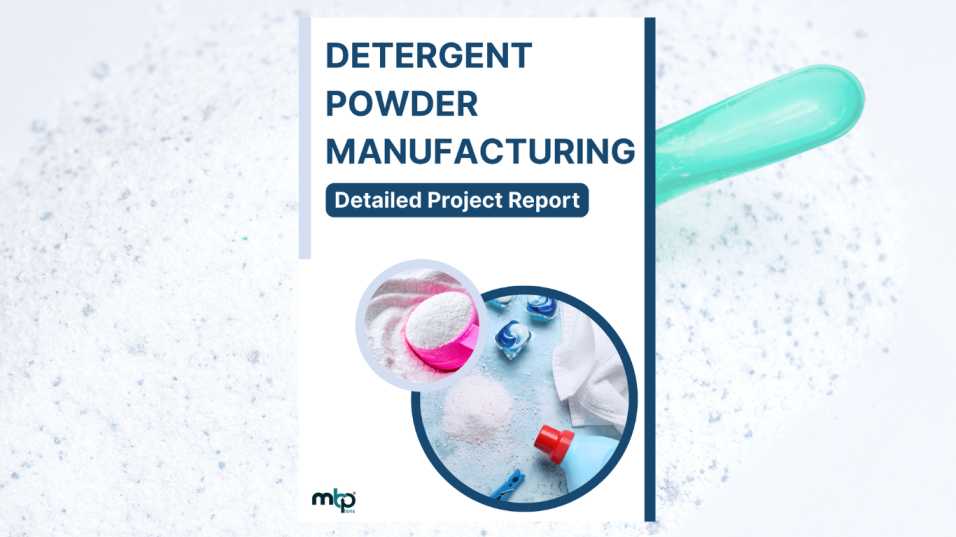
Detergent powder manufacturing refers to the industrial formulation and production of a free-flowing, water-soluble cleaning powder used for laundry, household, and institutional cleaning applications. This dosage format represents one of the most widely consumed home care products globally due to its affordability, cleaning efficacy, ease of transport, and long, stable shelf life. Detergent powder is manufactured by combining surfactants, builders, fillers, and functional additives such as enzymes, bleach, and perfume into a uniform, free-flowing granular product.
Detergent powder is manufactured through slurry preparation, spray-drying (or cold-mix agglomeration for lower-capex operations), post-dosing of heat-sensitive actives, screening, and weight-based packaging. Advanced facilities use tower spray-drying systems, ribbon blenders, cyclone dust-recovery units, and automated form-fill-seal packaging lines to ensure consistent particle size, bulk density, and cleaning performance across every batch.
Detergent powders can be broadly classified based on surfactant system and application. By type, the category includes anionic (LABSA-based), non-ionic, and enzyme-fortified biological powders. By application, products are formulated for machine-wash, hand-wash, and institutional or industrial laundry use. By positioning, the segment spans economy, mid-tier, and premium concentrated formulations, enabling manufacturers to address diverse consumer price points across urban and rural markets.
Growth Drivers
- Rising hygiene awareness and washing frequency across urban and rural households
- Growing washing-machine penetration driving demand for machine-compatible formulations
- Expansion of organized and unorganized retail distribution into Tier II, III, and rural markets
- Increasing preference for phosphate-free and eco-friendly detergent formulations
- Strong institutional demand from hospitality, healthcare, and commercial laundry sectors
Market Size & Outlook
Global Market:
- The global detergent powder market was valued at approximately USD 42.6 Billion in 2025 and is projected to reach USD 65.8 Billion by 2034, growing at a CAGR of 4.9%
- Asia Pacific dominates global consumption, driven by large population bases, price sensitivity, and strong cultural emphasis on fabric cleanliness
India Market:
- The India detergent market was valued at approximately USD 4.79 Billion in 2024 and is projected to reach USD 6.17 Billion by 2030, at a CAGR of 4.30%
- The powder segment continues to hold the largest share by form in India, led by strong penetration across Maharashtra, Karnataka, Tamil Nadu, and Delhi-NCR
The project reports provide detailed insights into:
- Industrial overview and market feasibility
- Technical and manufacturing feasibility
- Facility and equipment planning
- Regulatory approvals and quality compliance
- Sales feasibility and domestic/export market positioning
- Infrastructure, utilities, and operational planning
These reports offer a comprehensive feasibility analysis along with suitable business models and structured implementation plans.
Is detergent powder manufacturing profitable?
Yes. Consistent daily-use demand, low customer switching in value segments, and strong rural and semi-urban reach make this a sustainable, high-volume business.
What are the major end-use sectors?
Retail households, hospitality laundries, healthcare institutions, and commercial laundromats.
Are bank loans and funding options available?
Yes. The project reports are structured to support MSME loans, term loans, and investor funding proposals.
What approvals are required?
BIS certification, pollution control board consent, factory licensing, and effluent treatment compliance are mandatory.